Mutual recognition of 27 test results from 132 medical institutions in Beijing, Tianjin and Hebei (Figure)
As an important breakthrough for the coordinated development of Beijing-Tianjin-Hebei, the medical integration of Beijing-Tianjin-Hebei is running in small steps. With the implementation of more follow-up cooperation projects, the previously unbalanced medical relationship between the three places will be fundamentally changed, and the coordinated development of Beijing, Tianjin and Hebei will be further strengthened, and the big goal of benefiting the people in the three places will be truly realized — —
In recent years, the coordinated development of Beijing-Tianjin-Hebei is in full swing and has achieved a series of phased results. As a breakthrough of coordinated development, Beijing-Tianjin-Hebei medical integration is running fast in small steps. At present, Beijing-Tianjin-Hebei has basically realized the interconnection of medical technology, health emergency and disease prevention and control. In the next step, how to better disperse Beijing’s high-quality medical resources, realize the coordinated development of medical care in Beijing, Tianjin and Hebei, and truly solve the problem of "difficulty in seeing a doctor" has become a major issue facing Beijing, Tianjin and Hebei.
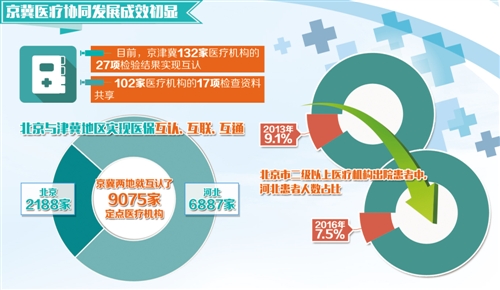
"At present, 27 inspection results of 132 medical institutions in Beijing, Tianjin and Hebei have achieved mutual recognition, and 102 medical institutions have 17 inspection data sharing. Beijing and Tianjin-Hebei have realized mutual recognition, interconnection and intercommunication of medical insurance. Only Beijing and Hebei have recognized 9075 designated medical institutions, including 2188 in Beijing and 6887 in Hebei. In 2016, among the patients discharged from medical institutions above the second level in Beijing, the proportion of patients in Hebei decreased from 9.1% in 2013 to 7.5%, and the coordinated development of Beijing-Hebei medical care began to show results. " Gao Xiaojun, member of the Beijing Municipal Health Planning Commission and spokesperson, introduced.
Hospital trusteeship:
The expert came to the door.
In the Department of Ophthalmology, Baoding Children’s Hospital, Hebei Province, the reporter met Liu Yuan (a pseudonym), a 6-year-old child from Tang County, Hebei Province, who had just successfully undergone nystagmus strabismus correction. This difficult operation is the first case in this hospital. Fan Yunwei, chief ophthalmologist of Beijing Children’s Hospital, told the reporter that she first met the little patient at Beijing Children’s Hospital at the beginning of this year. The child’s diagnosis was amblyopia and strabismus, and surgery was needed as soon as possible. At that time, her other identity was one of the "double directors" of the pediatrics department of Baoding Children’s Hospital, and she worked in Baoding two working days a week. She told the parents that the child’s surgery could go back to the local area and still be performed by her. "I didn’t expect to be able to do surgery at home, which saved us a lot of money." Liu Yuan’s mother couldn’t hide her excitement when interviewed by reporters.
"Department ‘ Double director ’ It is an innovative measure for us to entrust Baoding Children’s Hospital, that is, the former director of the hospital is mainly responsible for the daily operation of the department, and the director is appointed to be responsible for the discipline construction to ensure the service of patients and the improvement of the level. " Ni Xin, dean of Beijing Children’s Hospital, said.
At present, there are 8 outpatient docking professional departments, 10 ward docking professional departments and 3 medical technology departments in the two hospitals. In these departments, experts from Beijing Children’s Hospital participated in department management, outpatient service, ward round, consultation, teaching and discussion of difficult medical records. "Patients who dared not accept it before dared to accept it, and patients who could not be treated before could be treated." Yang Bin, director of the Second Department of Surgery, Baoding Children’s Hospital, said that due to the increasing number of difficult diseases that can be treated, there is no "off-season" in the surgical ward, and the sinking of experts has solved a big problem for patients.
Yu Guoxia, deputy director of the Department of Stomatology of Beijing Children’s Hospital, said that after the stomatology of Baoding Children’s Hospital was listed as a key supporting discipline after trusteeship, the number of outpatients increased by about 50% and the scope of treatment was wider. According to statistics, in 2016, Beijing Children’s Hospital sent 138 experts to Baoding Children’s Hospital and received 2387 patients. Experts were sent to guide all majors to treat 102 difficult new diseases and develop 53 new technologies.
"You don’t have to go to Beijing to see a doctor. Beijing experts are in Baoding." Gao Xiaojun said that Beijing Children’s Hospital hosted Baoding Children’s Hospital, which not only enabled patients in Baoding, Hebei Province and surrounding areas to get high-quality medical services in a timely and convenient manner, but also promoted the capacity of hosting hospitals, and also alleviated the state of "medical congestion" in the capital to some extent.
Co-construction:
Open a medical through train
In addition to hosting medical institutions, Beijing has improved the regional medical level through counterpart support, cooperation and co-construction.
Beijing — Hebei Yanda model is considered as a "model case". Since 2014, many medical institutions in Beijing have cooperated with Yanda Hospital in Yanjiao, Hebei. Among them, Beijing Chaoyang Hospital sent experts from several clinical departments, discipline construction consultants and medical management teams to support Yanda Hospital; Beijing Tiantan Hospital cooperated with Yanda Hospital in neurology; Children’s Hospital affiliated to the Capital Institute of Pediatrics, Beijing Hospital of Traditional Chinese Medicine and Hebei Yanda Hospital jointly set up a "Pediatric Disease Diagnosis and Treatment Center" and a "Chinese Medicine Comprehensive Diagnosis and Treatment Center".
Mr. Liu, a 60-year-old native of Langfang, Hebei Province, suddenly experienced dizziness and vomiting in early June. He was taken to Yanda Hospital in Yanjiao, Langfang, and was diagnosed as a right cerebellar infarction. The neurology department of Yanda Hospital quickly took measures, and Mr. Liu turned the corner. Pan Liyan, its attending doctor, said that as a private hospital, Yanda Hospital can now cope with cerebral infarction diseases like Uncle Liu through cooperation with Beijing Tiantan Hospital. "Tiantan Hospital experts have brought more advanced treatment plans, which allows us to do more perfect in the precise treatment of cerebral infarction." Pan Liyan said.
According to reports, at present, there are more than 130 management, medical and nursing talents assigned to Yanda Hospital, covering 17 specialties. Experts from Chaoyang Hospital have visited the hospital from Monday to Sunday. "When I first visited Yanda Hospital, there were only 7 patients a day. Now there are 68 beds at most, and we need to add beds in the corridor." Wu Hong, the head nurse who was sent to Yanda Hospital from Chaoyang Hospital, said.
In addition, after the signing of the direct settlement service agreement for Beijing-Hebei medical insurance in January this year, Beijing patients who seek medical treatment in Yanda Hospital can also realize the direct settlement of medical expenses by card after going through the referral procedures in different places. "From a small hospital with less than 30 patients in 1,000 beds to a large general hospital with more than 280,000 outpatient visits this year, there is no doubt that Beijing has imported a lot of ‘ Nutrient ’ 。” The relevant person in charge of Yanda Hospital said.
Collaborative development:
Break geographical restrictions
In addition to Beijing Children’s Hospital hosting Baoding Children’s Hospital and Beijing — In addition to Yanda’s medical service project, Beijing-Hebei joint projects include: serving Beijing, where Shougang and other enterprises in Beijing moved out — Caofeidian medical cooperation project; Beijing, which provides medical and health protection for the bid to host the 2022 Winter Olympics — Zhangjiakou medical cooperation project; Beijing, which aims to gradually form a regional medical center in the ecological conservation area in the northwest of Beijing, Tianjin and Hebei — Chengde medical cooperation project; To form a regional center of Beijing with certain medical radiation ability between Beijing and Shijiazhuang — Baoding medical cooperation project. At the same time, the medical and health services in Beijing, Tianjin and Hebei are gradually establishing graded diagnosis and treatment and two-way referral mechanisms in the region, and expanding cooperation in mutual recognition of medical test results and sharing of medical image data in the three places.
"Orderly resolving the function of Beijing’s non-capital is the strategic core of the coordinated development of Beijing, Tianjin and Hebei. While promoting the improvement of medical level in Tianjin and Hebei, it also reduced the proportion of patients from other places in Beijing. Between one liter and one drop, it has changed the previously unbalanced medical relationship between the two cities and made the coordinated development of the two places closer. " Gao Xiaojun said that the Beijing Municipal Health Planning Commission has strictly implemented the "negative list" system in the medical and health field in accordance with the overall requirements of the non-capital functional relief plan. On the one hand, strictly control the new medical resources in the East, West and Fifth Ring Roads of Beijing, and initially curb the blind expansion of large hospitals; On the other hand, guide the transfer of high-quality resources in the core area to areas with weak resources.
"The Beijing Municipal Health Planning Commission has planned about 20 municipal medical and health institutions to ease the project, with the goal of resolving more than 5,600 total beds; Through the communication with the National Health Planning Commission and the affiliated hospitals, a summary of the intention projects of 13 affiliated hospitals was initially formed. At present, a medical service belt consisting of 33 hospitals or hospitals has been initially formed in the surrounding areas of Beijing, with a total of 29,946 beds, accounting for 26.4% of the total number of beds in the city. " Gao Xiaojun said.
"Among the outpatients in medical institutions in Beijing, 69% are local patients in Beijing, and 31% are foreign patients. The most foreign patients are from Hebei, with more than 8.2 million person-times every year. From the data point of view, among the average daily medical visits of each doctor in the three places, Hebei is only about half of that in Beijing and Tianjin, which shows that Hebei should not only increase the allocation of medical resources, but also improve the efficiency of diagnosis and treatment. " Lei Haichao, director of the Beijing Municipal Health Planning Commission, has publicly stated.