The internationalization of RMB supports the opening of capital channels to serve the "Belt and Road"
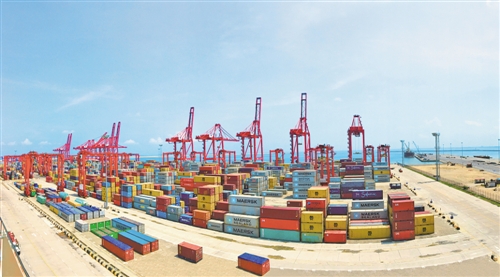
Although Sri Lanka is an island country, it lacks deep-water docks that can dock modern large ships. China Development Bank issued a loan of 330 million US dollars to support the South Port Project of Colombo Container Terminal, and built four new container berths, achieving a throughput of 1.56 million TEUs. The picture shows the port project. (data picture)
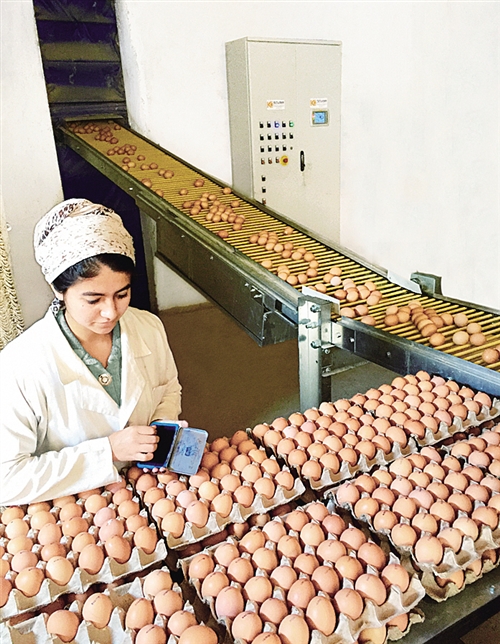
Tajikistan has long faced difficulties in financing agriculture and small and medium-sized enterprises. China Development Bank supports the development of small and medium-sized enterprises in Tajikistan by financing on the basis of mutual trust. The picture shows the production site of small and medium-sized enterprises in Tajikistan supported by CDB’s lending through Tower Savings Bank. (data picture)
editorial comment/note
With the interconnection of the "Belt and Road" infrastructure, global trade will achieve new rapid growth, giving birth to a large number of cross-border financial needs such as cross-border investment, trade settlement and currency circulation. In this context, with the opening of China’s financial market and the steady progress of RMB internationalization, China’s banking industry has also increased its support for the construction of the Belt and Road, and a financial cooperation network supported by market-oriented Silk Road Fund and commercial banks is taking shape, which will bring more convenience and preferential treatment to countries along the route.
Since the "Belt and Road Initiative" was put forward, a financial cooperation network led by multilateral financial institutions, China’s policy and development financial institutions and supported by market-oriented Silk Road Fund and commercial banks is taking shape. At the same time, the internationalization of the RMB has been steadily promoted and the two-way opening of the financial market has been accelerated, which has provided a more powerful guarantee for further consolidating and deepening the currency circulation along the Belt and Road.
The banking industry increased its support.
Financing is the essence of finance, and the long-term and huge investment and financing needs faced by the "Belt and Road" construction need to give full play to the role of finance. Infrastructure construction in many areas along the "Belt and Road" is generally underdeveloped, financial strength is relatively weak, and capital demand in infrastructure is urgent.
At present, a financial cooperation network supporting the "Belt and Road" construction is taking shape. By the end of 2016, CDB had supported more than 600 projects in countries along the Belt and Road, with a loan balance of more than 110 billion US dollars, covering infrastructure, capacity cooperation, financial cooperation and other fields. Last year, the Export-Import Bank supported 603 "One Belt and One Road" and international cooperation projects in production capacity and equipment manufacturing, with a year-on-year increase of 13% in loan balance and 208 "going global" loan projects with a year-on-year increase of 17% in loan balance.
This year, China’s banking industry will also increase its support for the "Belt and Road" construction. Hu Huaibang, chairman of CDB, said that in 2017, CDB will fully participate in the construction of the Belt and Road, including increasing financing support for international capacity cooperation in key countries and industries and strengthening the overall planning of capacity cooperation; Increase the impetus of major projects; Innovate business products, actively promote cross-border RMB business and promote inter-bank cooperation.
Speaking of the financial cooperation network on the "Belt and Road", Silk Road Fund has to mention. When it was established in December 2014, the purpose of Silk Road Fund was to serve the Belt and Road Initiative and promote interconnection. Since its establishment, Silk Road Fund has promoted a number of key projects. In 2015, the newly established Silk Road Fund made three "major events": supporting the Three Gorges Group to invest in the construction of clean energy such as hydropower stations in South Asian countries such as Pakistan, supporting China National Chemical Corporation to acquire Italian Pirelli Tire Company, and participating in the investment and financing of Russian Yamal LNG integration project.
The data shows that by the end of 2016, the actual investment of Silk Road Fund reached about 4 billion US dollars. Yang Zejun, Chairman of the Board of Supervisors of Silk Road Fund, introduced that there are more than 100 key tracking projects of Silk Road Fund, focusing on Russia, Central Asia, Bangladesh, China, India, Myanmar and Southeast Asia. In 2017, its investment scale is expected to maintain the momentum of the previous two years.
The landing of key projects has accelerated the pace of cooperation between China and countries and regions along the Belt and Road, injected new growth momentum into these countries and regions, and opened up a huge space for common development. China’s commercial banks are also the backbone.
Large Chinese banks, especially those with high degree of internationalization, can provide all-round financial services such as cross-border clearing, settlement, enterprise investment and financing. At present, about 10 commercial banks have set up more than 56 tier-one branches in nearly 30 countries and regions along the route, covering many countries and regions in Asia, Africa and Europe, covering industries such as electricity, transportation, oil and gas, minerals, telecommunications, machinery, park construction and agriculture, and basically achieving full coverage of key industries in the Belt and Road Initiative.
RMB internationalization brings convenience.
In recent years, the process of RMB internationalization has been steadily advanced, which has gradually consolidated and deepened the currency circulation between regions along the Belt and Road, and has become the basis for policy communication, road connectivity, smooth trade and popular support.
Large-scale infrastructure construction and frequent trade flows along the "Belt and Road" will inevitably be accompanied by large-scale demand for currency circulation. In this process, if the settlement cannot be made in time, or there are obstacles to payment, it will bring about an increase in transaction costs, which in turn will raise the risks of trade and investment.
Zong Liang, chief researcher of Bank of China, believes that RMB internationalization provides monetary support for the Belt and Road Initiative and promotes the in-depth implementation of the Belt and Road Initiative. Expanding the use of RMB will enable enterprises of both sides to avoid the exchange rate risk caused by the fluctuation of the value of the US dollar, and avoid the potential risk caused by the global monetary policy differentiation.
In recent years, the demand for RMB cross-border payment and settlement has increased rapidly, and the requirements for financial infrastructure have become higher and higher. Therefore, China is also committed to accelerating the pace of related financial infrastructure construction. On October 8, 2015, the first phase of RMB cross-border payment system (CIPS) was successfully launched. The system supports cross-border trade in goods and services, cross-border direct investment, cross-border financing and cross-border personal remittance, which helps to reduce the cross-border payment cost of RMB and has a positive impact on the real economy and enterprises’ "going global".
What is even more striking is that since October 1, 2016, the RMB has joined the International Monetary Fund’s "Special Drawing Rights" (SDR) currency basket, which is also an important milestone in the process of RMB internationalization. Zong Liang believes that at present, the internationalization of RMB has achieved initial results. The circulation and use of RMB among countries related to the "Belt and Road" has formed the advantages of closed-loop circulation, low risk and low cost, which will certainly bring more convenience and preferential treatment to countries along the route.
From Hong Kong to Singapore, from London to Frankfurt, many international financial centers have started offshore RMB business, and the scale of offshore RMB deposits has expanded rapidly.
Relevant experts said that next, in order to better serve the construction of the "Belt and Road", it is necessary to speed up the construction of international financial centers along the route and broaden the international scope and scale of RMB settlement.
The opening of financial markets provides guarantee.
From "panda debt" and "dim sum debt" to Shanghai-Hong Kong Stock Connect and Shenzhen-Hong Kong Stock Connect, and then to the establishment of several offshore RMB centers, the opening of China’s financial market has been further deepened, providing a better guarantee for the "Belt and Road" currency circulation.
In 2005, the International Finance Corporation and the Asian Development Bank issued the first "Panda Bond" in China’s inter-bank bond market. From 2015 to the beginning of 2016, overseas financial institutions such as HSBC, BOC Hong Kong and British Columbia, Canada successively issued RMB bonds in China’s bond market, which set off a wave of issuance of "panda bonds". According to joint credit statistics, in 2016, a total of 29 entities in China’s bond market issued 62 issues of "Panda Bond", with a total issuance of 127.44 billion yuan. At the same time, the "dim sum debt" market has expanded rapidly, with the circulation reaching 254.2 billion yuan and 116 billion yuan in 2014 and 2015 respectively.
On July 12, 2016, the BRICS New Development Bank issued 3 billion yuan of green financial bonds in China’s inter-bank bond market, which was the first time that multilateral development banks were allowed to issue RMB green financial bonds in the inter-bank bond market, and it was an important step for China’s bond market to open to the outside world.
In recent years, the opening of China’s capital account has been steadily advancing. At the end of last century, China had achieved full convertibility of current account; Since the beginning of this century, the degree of capital account convertibility has gradually improved, and basic convertibility has been realized under direct investment; We will steadily promote the convertibility of securities investment through open channels, including QFII, RQFII, QDII, RQDII, Shanghai-Hong Kong Stock Connect and Shenzhen-Hong Kong Stock Connect. As of November 28, 2016, the State Administration of Foreign Exchange has approved a total of 523.775 billion RMB RQFII quotas for 175 overseas institutions; Eighteen countries and regions have obtained RQFII pilot qualification, with a total investment of 1.51 trillion yuan.
In 2016, China’s capital account opening also had many bright spots, including the implementation of macro-prudential management of full-caliber cross-border financing; Further open and facilitate overseas institutions to invest in the inter-bank bond market and foreign exchange market; Optimize the Shanghai-Hong Kong Stock Connect policy and start the Shenzhen-Hong Kong Stock Connect pilot; Deepen the reform of qualified foreign institutional investors, and weaken the limit of quota and lock-in period.
At the same time, the People’s Bank of China has signed bilateral local currency swap agreements with central banks of more than 21 countries and regions along the Belt and Road Initiative, with a total scale of over one trillion yuan, and set up RMB clearing banks in seven countries.
Up to now, China has initially established a multi-level financial service system to serve the Belt and Road construction, effectively expanding domestic and overseas financing channels, improving cross-border financial services, and providing diversified financial support and services for enterprises to participate in the Belt and Road construction. In the future, China’s financial market will be further opened to the outside world, creating more favorable conditions and providing more powerful guarantees for promoting the smooth circulation of the "Belt and Road" currency.
Economic Daily China Economic Net reporter Chen Guojing