Xinhua News Agency, Wuhan, June 5th Title: There are new signs of illegal sand mining in the Yangtze River basin: stealing sand in the name of dredging and stealing sand in the form of "ants moving"
Xinhua News Agency "Xinhua Viewpoint" reporter
According to a recent survey along the Yangtze River by Xinhua Viewpoint reporter, under the high-pressure situation of continuous crackdown, the management order of sand mining in the main stream of the Yangtze River has continued to be stable and improved. However, driven by interests, some lawless elements turned their attention to tributaries and carried out sand mining in the name of "dredging project", and the cases of "ants moving" stealing sand showed a trend of multiple occurrences.
Illegal mining in the name of "dredging"
When the reporter visited along the tributaries, he met sand carriers many times, and most of his sand mining was under the banner of "dredging and dredging" and "comprehensive river management"
"On the surface, some ships are dredging engineering ships with complete certificates, but they are likely to engage in illegal sand mining activities, which is very concealed and makes it more difficult for us to crack down on illegal sand mining." Liu Pinggang, director of the Supervision Department of the Sand Management Bureau of the Yangtze River Water Conservancy Commission, said that this kind of dredging and dredging engineering ship is like an ordinary ship when driving, and sand can be mined by lifting sand mining equipment.
"The sand-stealing boat with six sand suction pipes can absorb about 2,000 tons of river sand in one hour and can sell hundreds of thousands of yuan." The police who handled the case of cracking the extraordinarily large case of stealing river sand told the reporter.
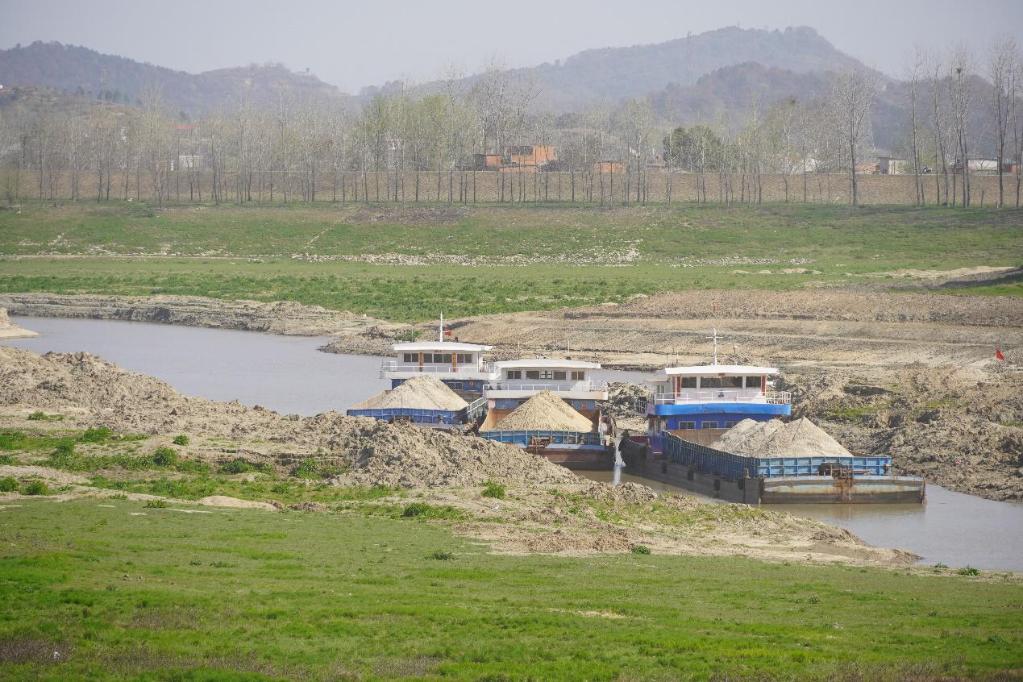
Three sand carriers full of river sand are driving on a first-class tributary of the Yangtze River. (Xinhua News Agency reporter Lu Zexin photo)
A university professor who has participated in the evaluation of water conservancy projects for a long time is worried that in some places, in order to obtain economic benefits and meet the needs of engineering construction, sand mining is carried out in the name of "dredging". "Many counties along the Yangtze River are queuing to apply ‘ Dredging ’ River course, for some people who come to me for review ‘ Dredging ’ I dare not sign the project. In order to avoid the supervision and approval of the higher authorities, some places also put the so-called ‘ Ecological dredging ’ The project is broken into parts, and the big project is cut into small projects. "
The reporter’s investigation found that some sand-stealing gangs also "washed white" illegal sand mining by falsely opening, forging and repeatedly using sand and gravel mining and transportation management sheets. In July, 2021, a multi-department joint law enforcement found that an invisible sand suction pump boat illegally mined river sand in a water area in the middle reaches of the Yangtze River. The police seized 15 sand and gravel collection and transportation management sheets that were falsely opened and resold, and each sheet sold for about 100,000 yuan.
"Ant moving" type sand stealing is difficult to prevent.
The reporter visited a tributary of the Yangtze River. After walking along the river for only two or three kilometers, he saw three small sand suction machines parked in the river. Some are small sand-sucking rafts, which suck sand in the water with pipes and can be operated by one person; Some excavators dig sand directly on the exposed riverbed and then transport it away with a small truck. The reporter saw along the river that due to excessive sand mining, many broken riverbeds were shocking: the river was covered with deep pits, the water in the pits became dead storage capacity, and the pits were dry and covered with weeds.
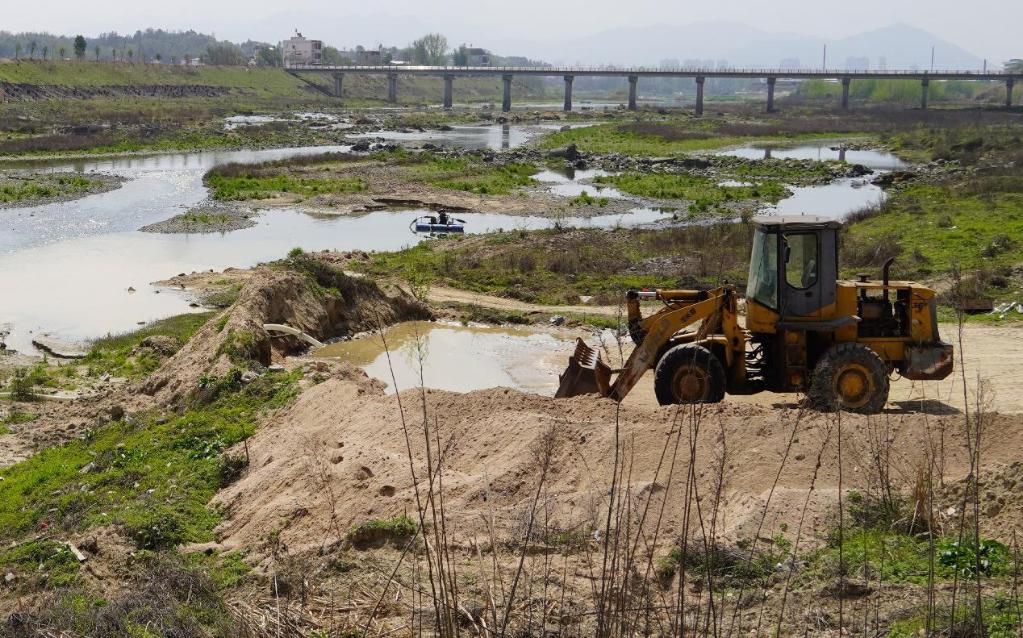
A sand mining site on a first-class tributary of the Yangtze River. After the reporter pointed out the problem, the local sand stealing machines were rectified. (Xinhua News Agency reporter Lu Zexin photo)
"There used to be river sand and gravel mining areas here. After digging for more than ten years, there is almost no room for large-scale mining. Now sand mining has been banned." A local township cadre said. However, although sand mining is explicitly prohibited, the continuous "ant moving" behavior of stealing sand has been repeatedly prohibited.
When visiting other tributaries in the middle and lower reaches of the Yangtze River, the reporter also found a similar situation. Water conservancy cadres and police generally said that through the implementation of "four orders" (sand mining and transportation management orders, generally in quadruplicate) management, increased inspections by means of science and technology, and frequent cross-departmental joint law enforcement, the number of illegal sand mining cases in the main stream of the Yangtze River has decreased year by year. However, the miniaturization cases such as "ants moving" stealing sand in the tributaries of the Yangtze River have become frequent problems at present, with great difficulty and high cost in law enforcement.
"Some villagers secretly sand mining. They stopped when we came, and went on picking when we left. We have no law enforcement power and are helpless. " A township cadre said frankly that especially since last year, the drought has caused the water level to drop and the riverbed to be exposed, so it is more convenient to steal sand by "ants moving".
In the middle of last year, Yongxiu County, Jiangxi Province detected an illegal mining case of "ants moving". In more than a year, five suspects, including Zhu and Liu, made hundreds of thousands of yuan in profits from "ants moving" to steal river sand.
A county-level city in Jingjiang section of the Yangtze River is famous for its high-quality river sand. The staff of the comprehensive law enforcement center in this area told reporters that it is difficult to enforce the law in the case of miniaturized sand mining. "In many cases, a small amount of sand was stolen many times, and the amount involved in a single case often failed to meet the filing standards."
During the interview, grassroots law enforcement officers told reporters that the low price of small sand mining tools is also one of the reasons for the frequent cases. The reporter searched on the e-commerce platform and found that a small sand pump with a silencer can be purchased for only about 3,000 yuan. "With a simple buoy, it can be used to extract river sand, and it can extract about 25 tons per hour." The merchant told reporters.
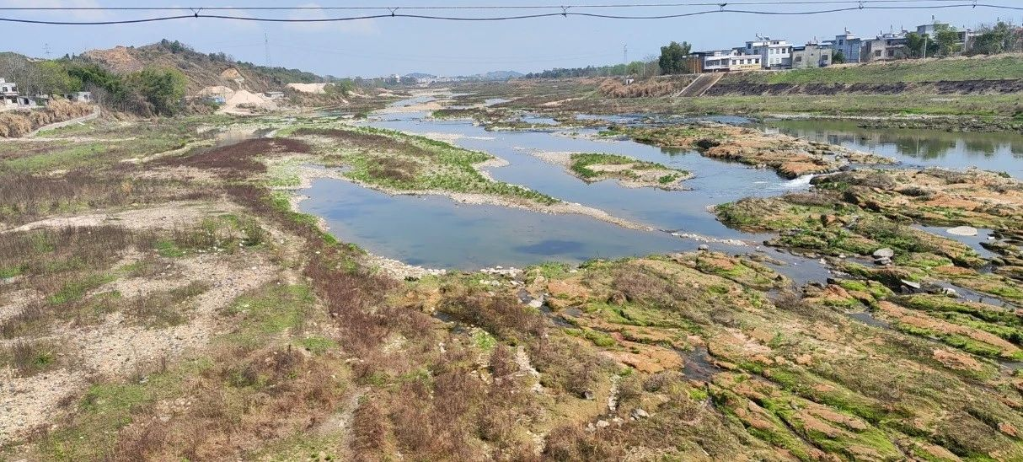
A riverbed near a sand mining factory in a tributary of the Yangtze River. (Photo by Xinhua News Agency reporter Dong Xue)
Li Jianhua, a professor at Tongji University’s School of Environmental Science and Engineering, and other interviewed experts said that the illegal exploitation of river sand will bring multiple negative effects: First, it will destroy the habitat of aquatic organisms and affect the ecology of the Yangtze River; Second, it may lead to the decline of groundwater level and the deterioration of water quality, endangering the drinking water safety of people along the river; Third, excessive sand mining will greatly change the riverbed topography and threaten the safety of dikes and ships.
Remediation of illegal sand mining should be promoted to tributaries
In 2022, the Ministry of Public Security organized 11 provinces (cities) in the Yangtze River basin and the Yangtze River shipping public security organs to carry out in-depth special operations to crack down on illegal sand mining crimes in the Yangtze River, and detected more than 270 such cases, destroyed more than 90 criminal gangs, seized more than 190 illegal sand mining and sand transportation ships, and verified more than 2.2 million tons of river sand involved, involving a total amount of 320 million yuan.
The relevant person in charge of the Yangtze River Water Resources Commission believes that with the economic recovery, the demand for sand and gravel may increase, and it is necessary to prevent the rebound of illegal sand mining driven by profiteering.
The Law of People’s Republic of China (PRC) on the Protection of the Yangtze River, which came into effect in 2021, clearly stipulates illegal sand mining: confiscate illegal income and ships, equipment and tools used for illegal activities, and impose a fine of more than two times and less than twenty times the value of the goods; If the value of the goods is less than 100,000 yuan, a fine of not less than 200,000 yuan but not more than 2 million yuan shall be imposed.
The relevant person in charge of the Yangtze River Water Resources Commission suggested that more attention should be paid to the management of sand mining in the relevant tributaries and lakes of the Yangtze River, and the management experience of controlling illegal sand mining in the main stream of the Yangtze River should be extended to the whole basin as soon as possible.
First of all, consider the sediment supply and resource distribution of the main tributaries and lakes as a whole, further improve the relevant system of comprehensive utilization of dredged sand and the approval process of dredging projects, and formulate management measures for comprehensive utilization of dredged sand that are in line with local conditions. At the same time, accelerate the intelligent supervision of sand mining, with "technical defense" as the main factor and "civil air defense" as the supplement, popularize electronic fence technology and electronic measurement technology, improve the automation and intelligence level of river sand mining supervision technology, and avoid legal projects from exceeding the time limit and exceeding the scope of sand mining.
Liu Pinggang and other people in the industry suggested that we should continue to strengthen the supervision of ship modification and reduce the number of sand-stealing ships from the source; Intensify the crackdown on "ant moving" illegal mining in the Yangtze River basin, and conduct regular inspections and surprise inspections of relevant river sections; Accelerate the unification of sand and gravel "identity cards" and implement closed-loop supervision over sand and gravel mining, transportation and sales related bills. (Reporter Lu Zexin, Dong Xue, Li Siyuan, Han Zhen)

关于作者