Fudan business knowledge from the perspective of original management

Original author Sun Shuhua
Associate Professor tulane university.
Rewriter Liu zhi
Associate Professor Peking University.
Political skills, if used improperly, may make colleagues feel threatened and cause vicious competition among employees.
Organization is like a political arena. In addition to professional ability, political skills are also an important ability to succeed in the workplace. Different from "playing politics" or "political games", "political skill" is a neutral word, which refers to effectively understanding others in the workplace and using one’s own knowledge to influence others’ behavior, thus promoting the ability of individuals or organizations to achieve their goals. People with political skills have higher sensitivity in social interaction, are better at building social networks, have stronger interpersonal influence and control, and can express themselves more sincerely and manage others’ impressions of themselves. Practice and research have found that political skills can bring a variety of positive consequences, such as better popularity, establishing high-quality relationships with more core members of organizations, flexibly adjusting interpersonal interaction methods according to situations, communicating more with leaders, more organizational resources and social capital, and more opportunities for development and promotion.
However, Sun Shuhua, an associate professor at tulane university Business School, cautioned: Don’t think so beautifully about political skills. If you are not careful, political skills may become a "pit", making its owner the object of "attack" by colleagues.
one
Threat perception of social status
In the process of development, human society has evolved status and rank, and everyone has the motivation to protect and compete for their social status. Therefore, the social rank theory suggests that human beings have formed a cognitive system about social rank in the process of evolution, and constantly evaluate the existing and potential status threats. An important factor affecting threat perception is the ability of others to get positive attention from society. People often hope that they can leave a very attractive impression on others, because society always gives people with these characteristics a higher status. The ability to gain social attention is just a part of political skills, which is why employees with strong political skills easily make their colleagues feel threatened by their status.
The social hierarchy theory also suggests that employees have a strong motivation to eliminate threats, and even do not hesitate to take interpersonal derogatory behavior, that is, deliberately destroy the interpersonal relationship, work achievements and reputation of the target employees, such as spreading rumors, deliberately delaying work, making the target employees unable to complete their tasks on time, and conveying some false or misleading information to other colleagues. In order to achieve his goal, he may dig up his opponent’s "black material" to damage his reputation, destroy his original attraction and weaken or eliminate his opponent’s competitive advantage. Some studies have found that although these tricks are despicable and insidious, they are still quite attractive to him. Therefore, once employees with stronger political skills are regarded as threats by colleagues, they may become the target of being derogated.
2
The intensification of confrontational relations
If in the eyes of employees, colleagues with political skills have a "confrontational relationship" with themselves, the sense of threat and derogatory behavior will further escalate.
Confrontation refers to the long-term competitive relationship between a person and a specific goal. In a confrontational relationship, the two sides are often in the same position, and there has always been competition and it is difficult to tell. In the organizational context, this kind of competition may be related to bonuses, promotion, status and influence, and the recognition of leaders. Confrontation is often not about a certain competition or the immediate result, but a general understanding of the relationship between the two people formed in the process of long-term infighting with the opponent. Even if there is nothing to compete for, this confrontational thinking will make people have to compete for it.
Employees who feel antagonistic relationship will be very concerned about winning or losing, and the psychological significance of defeating opponents is even greater than the practical significance. Employees with strong political skills are good at winning support from superiors, establishing alliances with strategic partners, and mobilizing these resources when the competition requires. In the eyes of colleagues who regard them as opponents, they are masters of playing political games, who will form gangs and use tricks to gain higher status, which will bring a stronger sense of threat to colleagues and force them to win at all costs. However, unscrupulous means that it is likely to cause harm and injustice to others, which is a test of human nature. After all, doing bad things also requires psychological energy. In order to reduce this psychological cost, people will exclude their opponents from moral considerations and think that what kind of behavior they take against their opponents should not be subject to moral constraints.
In a word, when employees regard colleagues with strong political skills as adversaries, they will feel more threatened and more likely to take destructive actions against them.
The following four studies verify these assumptions one by one.
Study 1 recruited 211 professionals. They should first choose a colleague whom they always compare, and evaluate the political skills of the colleague and the degree of confrontation between them. After a week, the subject needs to answer several questions to measure his threat perception and interpersonal destructive behavior, such as "this person poses a threat to my work position" and "I have spoken ill of this person behind his back".
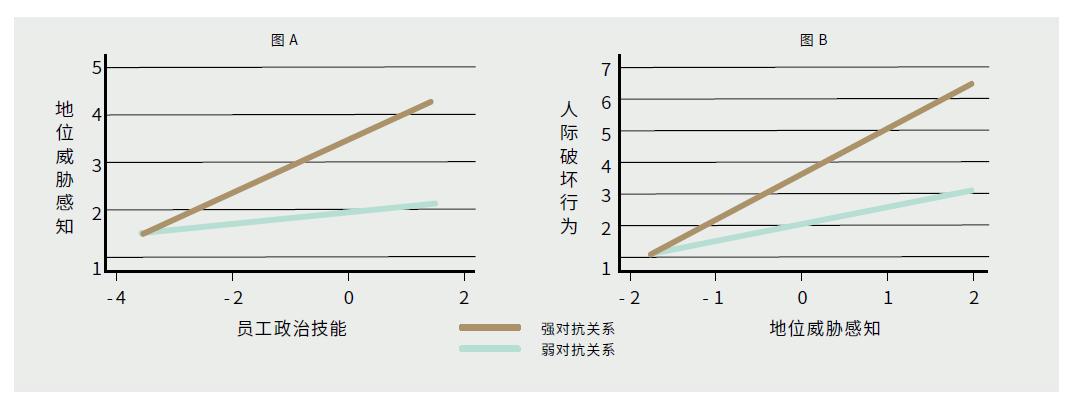
The Relationship among Political Skills, Threat Perception and Disruptive Behavior
The results are consistent with expectations. The higher the political skills of colleagues, the stronger the threat perception of the subjects and the more derogatory behaviors they take. In addition, as shown by the brown line in Figure 1A, when the subjects think that there is a confrontational relationship between two people, the political skills of the opponents are more positively correlated with the threat perception of the subjects; At the same time, as shown by the brown line in Figure 1B, with the enhancement of threat perception, the possibility of subjects taking interpersonal derogatory behavior is also increasing. The blue line in the two pictures shows that the possibility of this series of negative reactions will be much weaker when the subjects do not regard the colleague as an adversary …
This article is an excerpt.
The full text was published in the 31st issue of Management Vision.
Original title: "Social cattle in the workplace may become" eyesore "for colleagues"
Read the original text

关于作者