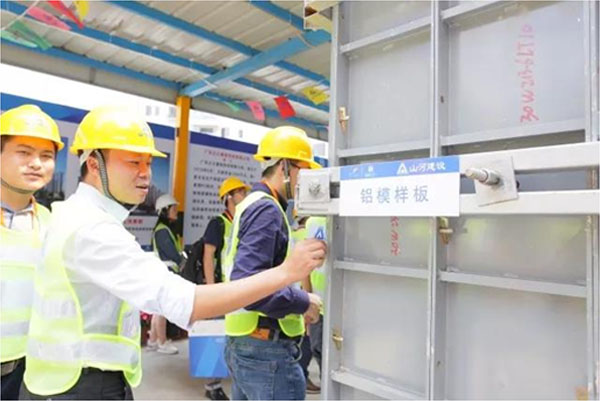
Country Garden Group’s engineering management personnel inspected the SSGF construction site.
Entering the first year of fully implementing the spirit of the 19th National Congress of the Communist Party of China, Country Garden Group got off to a good start.
On January 5, 2018, Country Garden announced that the company achieved contracted sales of about RMB 550.8 billion in 2017, ranking first in the same industry for the first time.
In the past two years, Country Garden’s performance has been growing by leaps and bounds. In 2015, Country Garden achieved contracted sales of 140.2 billion yuan, and in 2016, it directly passed the 200 billion yuan mark, reaching 308.84 billion yuan. Today, the contracted sales have broken the two barriers of 400 billion and 500 billion, and directly rushed to 550.8 billion yuan.
Country Garden’s rapid development and becoming the industry leader can be attributed to its initial intention to build a good house and its ability to build a good house at a fast speed-"good" is enough to win the market, and "fast" can control costs, expand scale and benefit owners. The two complement each other and are indispensable.
After visiting the headquarters of Country Garden Group and several projects around it, we can find that behind the "good and fast", the "good house strategy" put forward by Country Garden in recent years, the continuous tempering of all-industry consolidation capacity, and the gradual spread of SSGF industrial construction system are the joint efforts. These measures and efforts are the efforts of a leading enterprise in the industry, and they also contain a deep understanding of corporate social responsibility and a feeling of home and country of a national brand enterprise in the great era of "Chinese Dream".
Good quality, ingenuity to build a good house
"Our buildings are 70 meters apart, and other properties are usually only 40 meters. Our plot ratio is 1.8, and local real estate has generally reached 3.0. " In Shixing County, Shaoguan City, Guangdong Province, Country Garden salesman Xiao Huang was particularly confident when introducing his own real estate.
In a small county town in northern Guangdong with a total population of 250,000, except Shixing Country Garden, there is currently no real estate with two ladders and two households, and no children’s activity space in any community can be carefully subdivided into three areas according to age.
"In Shixing County, we are the undisputed market leader." Standing on the stone bridge across the Mojiang River, Wang Jin, the person in charge of Shixing Country Garden Project, spoke quietly, but could not hide his heroism. Looking at the surging river, the general manager’s only regret is that Country Garden has not yet got the Linjiang project in Shixing County.
Wang Jin’s confidence comes from the test of the market. On October 3, 2017, the first phase of Shixing Country Garden was opened, and the removal rate reached 96% that day.
Ms. Xu, Xiao Huang’s customer, has been happy to buy a new house for herself that day. Although her current residence has just been purchased for five years, she still decided to sell it to replace the new house in Country Garden.
"My original house is also very good. However, the greening, property management and security measures of Country Garden are really different from other real estates. " Ms. Xu decided to choose Country Garden as the retirement home for her and her husband. She said that living in Country Garden Community is "upscale".
Market feedback made Wang Jin full of confidence in the next sales. However, he also admitted that before the project opened on October 3 last year, he actually had no bottom in his heart.
Wang Jin’s worry has nothing to do with the brand of Country Garden. There is no better house in Shixing County than Country Garden. In fact, Country Garden is the undisputed leader in the real estate market of Shaoguan City.
Wang Jin’s superior Country Garden Guangqing regional executive president and general manager of Shaogan City Company Lan Yi worked in Shaoguan market for more than two years, and Shaoguan’s market share rose from 20% to about 38%. Lan Yi said that Country Garden achieved about 8.4 billion yuan in Shaoguan’s market of over 22 billion yuan.
Wang Jin is not sure about the apartment type. According to the past sales data, the best-selling apartment in Shixing County is about 80 square meters. However, in recent two years, Yang Guoqiang, Chairman of the Board of Directors of Country Garden Group, pushed the "good house strategy" within the group, and good apartment layout was one of the key points. The property of Shixing Country Garden is mainly 4-bedroom apartment of 140 square meters, and the smallest apartment is 3-bedroom apartment of 115 square meters.
"At first, I was a little resistant. Sales data show that the best seller in the past was a two-bedroom apartment of 70 to 80 square meters. Can the market in Shixing County accept large-sized units? " On the bank of the Mojiang River in January 2018, Wang Jin felt that he had not seen far enough three months ago. In the end, the 140-square-meter apartment was sold out on the first day of opening.
"Our house really meets the needs of improved owners. It has played a leading role in the local market. " Lan Yi concluded that Shaoguan market is one of the lowest-priced prefecture-level cities in Guangdong Province. The local market is dominated by improved demand. "The group has promoted the’ good house strategy’ for two or three years. My understanding is that good products, good quality, good environment, good facilities and good properties will give the people a sense of gain."
According to insiders of Country Garden, when Yang Guoqiang first put forward the "Good House Strategy", there were many opinions from the enterprises, especially the front-line marketers. But in just two years, the development of Country Garden has proved Yang Guoqiang’s vision as a successful entrepreneur.
The report of the 19th National Congress put forward that "China’s economy has shifted from a high-speed growth stage to a high-quality development stage". The Central Economic Work Conference held at the end of 2017 also made it clear once again that promoting high-quality development is the fundamental requirement for determining development ideas, formulating economic policies and implementing macro-control at present and in the future.
Nowadays, the clarity of national policies has enabled Country Garden to reach a complete consensus on the "good house strategy".
"The media are discussing the problem of destocking in the third and fourth lines. Now the real situation of the 345 line is that there is no shortage of houses, but there is a shortage of good houses, and good houses are not necessarily the most expensive to sell, but they must be the most attentive. " Wang Jin said.
The window is attached to the outside of the external wall, so that the owner can use the windowsill to store more toiletries; The doorframe sits on the threshold, instead of landing directly, in case it is damaged by water and moisture; The edge of the sink must be rounded; The shower room cancels the water retaining stone, and uses the height difference between inside and outside to prevent the old people from falling down … In Country Garden, a small bathroom also reflects Country Garden’s intention to provide a "good house" for the owners.
What kind of company has what kind of boss. About Yang Guoqiang, Chairman of the Board of Directors of Country Garden Group, there was a story that was widely circulated.
The floor drain is an interface for discharging water to the pipeline. If the floor drain is not done well, the bathroom will often smell. In May 2016, Yang Guoqiang put forward the idea of improving the floor drain, immediately drew a schematic diagram, and later drew a design draft. He led the team to change the floor drain model six times, and even revised the drawings in the car when he was on a business trip.
The floor drain designed by Yang Guoqiang was finally finalized. Compared with the floor drain in the market, the structure is simpler, the multi-part deodorizing storage is changed into an integrated design, and the height of the water seal is increased from 5 cm to 6 cm in the national standard, thus ensuring a better deodorizing effect and greatly reducing the cost by 60%. At present, this floor drain is applying for a national patent. Zheng Jianhui, general manager of Tengan Electromechanical Company, commented that this design is in a leading position in technology in China.
Within Country Garden, Yang Guoqiang insists on building houses in accordance with the principle of "safety, applicability, economy, beauty and durability", so as to build a smart home that meets customers’ needs and has market premium.
On December 26, 2017, Country Garden Group held a conference in Shunde Headquarters, Foshan, Guangdong Province to commend more than 60 outstanding partners in the construction field. At the commendation meeting of excellent partners, Yang Guoqiang said: "Country Garden is developing, and high quality ranks first."
Mo Bin, president of Country Garden Group, wrote in his 2018 New Year message to internal employees: "We have long grasped the lifeline of quality and property management. While innovating internal control management and realizing scale expansion, we have paid more attention to developing quality and embarked on the’ Country Garden Road’ that suits us."
"President Yang proposed that’ I hope the society will become better because of our existence.’ Country Garden’s’ Good House Strategy’ is also a supply-side reform in a sense. Zhu Jianmin, vice president and spokesperson of Country Garden Group, said.
The good houses in Country Garden have established a good reputation in the market. High quality is the fundamental driving force for the rapid development of Country Garden in 2017.
"A few years ago, our living environment was not very good, and many places around us were dirty and messy. Since Country Garden entered the development, the urban environment has been greatly improved, and now many employees working in urban areas have bought their own homes in Country Garden. Such a change has undoubtedly played a role as a weather vane for a county-level city like ours. " Zou Ganhao, director of the Gaoyao District Committee Office in Zhaoqing City, Guangdong Province, said in an interview.
It is understood that in 2017, Country Garden focused on the "Ten Red Lines" of quality management and engineering control measures such as anti-leakage and anti-cracking to further improve the quality of the project.
High speed, remarkable achievements in the whole industry chain.
The 9th floor of Country Garden Headquarters is the office of Shunyin Greening Company. Liang Guokun, the head of this company, is the original creator of Country Garden Golf Stereo Garden and the executive director of Country Garden Group. In the commercial map of Yang Guoqiang, Shunyin Company is responsible for the landscaping of all projects in Country Garden. At present, Shunyin Company, which has more than 7,000 employees, basically does not accept business outside Country Garden.
"We grew up with Country Garden." Liang Guokun said.
Yang Guoqiang, Chairman of the Board of Directors of Country Garden Group, who advocates building a new international capacity cooperation city along the "Belt and Road" in Malaysia, has always regarded landscaping as a "nuclear weapon" in the competitiveness of Country Garden. Country Garden’s projects are all over the country. In order to make a landscape more in line with local characteristics, whenever Liang Guokun goes to a new place, he must first visit the earliest local botanical garden and the latest park to learn from it. In his view, the landscaping shoulders the expectation and yearning of the citizens for the living environment, and he never dares to slack off.
What makes Liang Guokun relish is Country Garden’s project in Lanzhou City, Gansu Province, and its three-dimensional golf garden is a typical epitome of his landscape transformation and landscaping techniques. As we all know, Lanzhou is located in the upper reaches of the Yellow River, with little precipitation all the year round, heavy wind and sand, and the surrounding area of the project is deserted. It was the most arduous and difficult project in terms of living and construction conditions since the establishment of Country Garden Group. At that time, Yang Guoqiang demanded that "the Lanzhou New Town Project should be turned into an oasis on the Loess Plateau no matter what method or how much money it costs". Liang Guokun is deeply committed to this. By surveying the terrain, studying the soil, visiting and analyzing the surrounding environment, real estate, and municipal facilities, he put forward ideas and plans that suit the local conditions of the Lanzhou project. With years of senior attainments in terrain design, he solved many problems such as soil, irrigation, seedlings, etc. in a timely manner with wisdom and team strength, and broke the "Arabian Nights" of the "oasis from heaven" that everyone suspected in 90 days. The fairy tale picture of 150 stone deer running to the community with vigor and joy is outlined, and the artistic conception of 200 flocks of sheep roaming in the oasis, which has become a touch of green for Lanzhou’s best poetry and interest. This landscape helped Lanzhou New Town project break through 5 billion sales in the first four hours in 2013, creating and refreshing many records of China real estate industry at that time.
Adhere to Country Garden, which builds a good house, and at the same time achieve the lowest average price among the top ten domestic real estate enterprises. Landscaping is an important part of Country Garden’s entire industrial chain. In the implementation of Country Garden Group, especially Yang Guoqiang’s own intention, Shunyin Company is highly effective. "If Country Garden outsources the garden instead of Shun Yin, it may not be able to control the outsourcing company well." Liang Guokun said.
According to Liang Guokun, Yang Guoqiang himself attaches great importance to landscaping and has his own opinions. His home is only 640 steps away from Yang Guoqiang’s home. Once you encounter any problems, you can always ask Yang Guoqiang for instructions, which is also an unrepeatable model for the rapid development of Country Garden.
Country Garden’s business chain covers almost all aspects of real estate development, including project positioning, design, construction, decoration, pipe pile, home, marketing, property management, education, transportation, supermarkets and other supporting facilities. In order to obtain the profits of each link in the value chain and realize low-cost and fast-speed development, Country Garden was evaluated by the media as an "integration expert" in the real estate value chain.
Country Garden Design Institute has more than 30 branches around the world, with nearly 4,000 employees. Most of the projects in Country Garden are designed by their own design institutes. From pre-planning and scheme and decoration, to road and bridge design, survey, BIM technology, etc., it seamlessly meets the requirements of the real estate sector for the entire product line.
In 2017, Country Garden Design Institute completed nearly 900 projects. Country Garden usually begins planning research at the stage of project site selection and land acquisition. Designers and engineers will work with project colleagues to design products in combination with marketing suggestions on product composition, project location and market prospects, and constantly improve the design during negotiations with the government. Relying on the efficient cooperation of this multi-integration, the project design of Country Garden can be completed quickly and with high quality, so that Country Garden can always maintain ultra-high-speed operation.
"If you don’t have your own design institute, you must first do a lot of preliminary research, and the second is to find an external design institute to cooperate. Moreover, the design standards and service efficiency of the outsourcing design institute may not be able to match the needs of enterprises, and everything will be a lot of trouble, and we require that the work be completed as quickly as possible. " Chief designer Huang Yu Ling said.
Country Garden Design Institute has a project coordination meeting every week. If a project encounters difficulties, immediately pull the WeChat group to form a research group for horizontal linkage and communication to solve the problem.
Country Garden collects many valuable opinions from owners all over the country every day. Among them, the opinions related to design will be quickly fed back to the post-design joint evaluation team for research and demonstration.
"When we receive the customer’s comments, we will evaluate and demonstrate them at the first time and give feedback. If the comments are feasible, we will implement them immediately after approval for rectification." Huang Yu Ling said.
The project has been opened for more than 6 months, and the cash flow has returned to normal for more than 9 months. It is with the whole industrial chain that the industry usually needs to develop projects for several years, and Country Garden can do it in one year. Low-cost land, large-scale production and rapid sales … Country Garden can achieve a huge scale of 550.8 billion today and its sound industrial chain complement each other.
Zuo Ying, deputy general manager of Country Garden Group Financial Fund Center, said that in Country Garden, 1 yuan can be turned over on average 1.5 times a year, and if it is fast, it can reach 2 times, which is a leading level in the industry.
Some critics believe that, in a sense, Country Garden is a real residential developer who has realized industrialized production, and can produce and sell his own house at a high speed like an assembly line.
Yang Guoqiang once said, "Build a good house that ordinary people can afford". "Good for people, good for society" has always been the initial heart of this entrepreneur from the bottom. Country Garden’s mature and efficient development of the whole industrial chain has provided strong support for Yang Guoqiang’s ideal.
Good and fast, the construction system is industrialized
If the focus of "Good House Strategy" is good and the development of the whole industrial chain is fast, the SSGF industrialized construction system launched by Country Garden in 2017 provides sufficient impetus for Country Garden to reach a new level in the two dimensions of "good" and "fast".
Zhang Zhouyun, from his hometown of Anhui, has been working outside for 28 years. He has been making wooden models on construction sites for a long time, and said that his craft work will soon be eliminated.
However, Zhang Zhouyun is not worried about his livelihood. In 2017, he participated in SSGF skills training in Country Garden. Now Zhang Zhouyun, who works in the Country Garden Phoenix Bay project in Ronggui Town, Shunde, Guangdong Province, has started to use aluminum alloy templates instead of wooden molds. This is the requirement of SSGF industrial construction system.
"In the past, the angle of Yin and Yang was made of wooden patterns, which required 90 degrees. How many deviations would be made. Now using aluminum mold, 90 is really 90. " Zhang Zhouyun said that his work efficiency has been greatly improved. However, what makes him most happy is that he used to spend one day in 300 yuan on the construction site, but now he has increased to one day in 500 yuan. To this end, Zhang Zhouyun is very supportive of the SSGF system gradually introduced by Country Garden in 2017.
It is understood that SSGF industrial construction system is a new type of assembly and building industrialization solution developed by Country Garden, with four core concepts of "Sci-tech technological innovation", "Safe&share safe sharing", "Green green sustainability" and "Fine&fast high quality and efficiency". Based on the industrialization of assembly, cast-in-place, electromechanical and interior installation, it integrates hierarchical standardized design, aerial assembly of molds, full-interspersed construction management and artificial intelligent application.
This construction system with many advantages such as high quality, high speed and low energy consumption can be called the most revolutionary measure of Country Garden in 2017. Liu Dongwei, chief architect of China Institute of Building Standards Design and Research and chairman of the Building Standardization Committee of the Ministry of Housing and Urban-Rural Development, believes that SSGF is of strategic significance for the transformation and upgrading of construction methods.
According to the staff of Country Garden, SSGF is different from the traditional manual wall-building method and the general assembly method of assembling external walls. It uses aluminum formwork to build external walls and reinforced concrete to cast them in one step. The walls are smooth and do not need plastering, which improves the overall safety and impermeability, realizes self-waterproofing of the structure and effectively solves the problems of leakage of external walls and windows.
At the same time, SSGF industrial construction system is very beneficial to full-interspersed construction because of the climbing frame with good sealing and protection for high-altitude operation and the floor water interception system that can block and drain construction water and rainwater.
"Now the house is still being built upstairs, and the decoration can start downstairs. This shortens the construction period by 8-10 months. " Li Xiaojun, project manager of Phoenix Bay Project in Ronggui Country Garden, said.
Among the projects that Li Xiaojun is responsible for, 4 of the 21 buildings adopt SSGF industrial construction system. The pilot building started construction in June 2017 and is expected to be delivered in June 2018. At the beginning of January 2018, the 31-storey Building No.8 and Building No.9 had been built to the 29th floor after half a year of construction, and the decoration had reached the 19th floor, and the basement had been fully completed.
The construction period saved by SSGF system, on the one hand, allows the owner to buy a house at the beginning of the year and carry a bag at the end of the year, saving a considerable rent, on the other hand, it accelerates the capital turnover of Country Garden, which is of great significance to the rapidly expanding Country Garden.
"My peers in the society are also asking me, with such rapid development and more than 1,000 properties, how do you control them? Can your internal control keep up?" Mo Bin, president of Country Garden Group, stressed that SSGF technology is the answer, through which the quality of the house will get better and better.
In addition to improving quality and shortening construction period, SSGF process construction system gives others the most intuitive impression that the whole construction site is clean, tidy and beautiful, the surface of the building blank wall is smooth and flat, and no mortar mixer is seen. This is completely different from the messy scene of construction sites in the past.
"In the past, we didn’t dare to wear leather shoes when checking the construction site. Now the leather shoes are still clean after walking around. With the SSGF system, our construction site can be open to the owners all day. " Li Xiaojun said.
According to the calculation, every floor of SSGF is assembled by molds in the air and cast in one step, which can completely eliminate masonry and plastering, greatly reduce the use of wood, sand and gravel, reduce carbon dioxide emissions and land occupation, and greatly reduce environmental costs and energy costs.
Take the newly started housing area of 1.67 billion square meters in China in 2016 as an example. If SSGF construction system is adopted, it can reduce the total carbon dioxide emissions equivalent to the global aviation industry, reduce hundreds of millions of tons of decoration waste, save 700,000 people’s domestic water for one year, and save forests equivalent to twice the area of Shanghai and river sand equivalent to five times the sand discharge capacity of the Pearl River.
Lan Yi, executive director of Country Garden Guangqing District and general manager of Shaogan City Company, is in charge of Shaoguan City. Currently, there are two projects for SSGF pilot. He concluded: "After using SSGF, workers’ wages have increased, although the hard cost of construction has increased, but the construction period has been shortened, the whole cycle cost will decrease, and the comprehensive cost will also decrease."
As the head of a city company, Lan Yi strongly felt the local government’s interest in SSGF system. "SSGF’s advantages in quality control, safe and civilized construction, energy conservation and environmental protection are in line with government requirements and respond to the green and sustainable development advocated by the state." Lan Yi said.
It is reported that by the end of 2017, Country Garden has piloted the SSGF industrial construction system in 108 projects in 46 regions, which are distributed in more than 20 provinces including Beijing, Guangdong, Sichuan, Chongqing, Jiangsu, Hubei and Hebei. In 2018, Country Garden will implement SSGF on a large scale.
At the "SSGF Industrial Construction System Site Meeting" held on September 29th, 2017, Mo Bin, President of Country Garden Group, said: "Our Country Garden’s implementation of SSGF is a response to the call of the national housing industry and a basic requirement of the construction industry. It is also a concrete manifestation of our Country Garden’s efforts to build a quality management year and build a good house for the whole society."
New mission, for a better society.
In the past 2017, Country Garden had many happy events-
On July 20th, Fortune magazine released the list of the world’s top 500 in 2017, and Country Garden made the list for the first time.
On September 21st, Fitch, one of the three international authoritative credit rating agencies, upgraded Country Garden’s corporate credit rating to investment grade.
On November 10th, Country Garden was selected as a constituent stock of Hang Seng Index and promoted to blue chip.
……
Also in 2017, Country Garden Group did a lot of things that may seem to have little to do with 550.8 billion sales in the short term-
Officially released the long-term rental apartment brand "BIG+ Bijia International Community", and plans to develop 1 million long-term rental apartments in three years, focusing on building long-term rental cities and implementing the policy of "both renting and purchasing";
In the Pearl River Delta, Yangtze River Delta, Beijing-Tianjin-Hebei, Bohai Rim and other places, a number of characteristic towns were laid out to build an industrial platform and help the real economy. The first benchmark project, Tonghu Science and Technology Town, was rated as a demonstration site for the creation of Guangdong characteristic towns by the Guangdong Provincial Development and Reform Commission.
Donated about 500 million yuan to help 78 poor villages in yingde city, Qingyuan, Guangdong, and promised to achieve "one year out of poverty and three years of revitalization";
Actively participate in the implementation of the national innovation-driven development strategy, and set up the "Tsinghua-Country Garden Science and Technology Innovation Fund" with Tsinghua University to support Tsinghua’s scientific and technological research and the transformation of its achievements;
……
Can today’s actions, like the "good house strategy" put forward by Yang Guoqiang two years ago, pave the way for Country Garden to reach a higher level in the future?
At the work conference of Country Garden Group in 2018, Yang Guoqiang said: "Let’s make unremitting efforts with one heart and one mind to improve ourselves and create a better society, and we will live a better and happier life."
The report of the 19th National Congress put forward the rural revitalization plan, and Yang Guoqiang, who was born as a farmer, seemed to be hit by something. In fact, his heart still maintains his love for the land and the countryside. At the annual work meeting, he told the executives and employees of the whole group that I was farming 40 years ago, and I still want to go back to farming 40 years later. I hope everyone will support me.
Perhaps it is more to face yourself, "Country Garden has the conditions and responsibility to do something for rural revitalization today …"
(Article reprinted from: Xinhua Daily Telegraph)