Core reading
On September 18, 2019, General Secretary of the Supreme Leader emphasized at the symposium on ecological protection and high-quality development of the Yellow River Basin that the Yellow River should be a happy river for the benefit of the people.
We will jointly do a good job in great protection and jointly promote great governance. For the sake of the mother river, an exploration of river protection and management is carried out in the Yellow River. Implement unified water management and dispatching, carry out deep water saving and water control, and systematically control soil erosion … … The water resources department regards great protection as the key task, and makes good use of water resources strictly from a narrow tube and carefully calculates and uses water resources. From 1999 to August this year, the Yellow River has been continuously flowing for 23 years.
Dongying, Shandong, the Yellow River estuary.
The river flows towards Wan Li, flowing, spreading and entering the sea. Here, I witnessed the Yellow River’s appointment as scheduled for 23 consecutive years.
Once upon a time, because the Yellow River was cut off, it was another scene here. Sand covers the riverbed and birds stay away from home. From 1972 to 1999, during the 28 years, the main stream of the lower Yellow River was cut off for 22 years. When the cut-off was the most serious, it was 704 kilometers away from the estuary. At one time, the river ecosystem was on the verge of collapse, the wetland area shrank, and the production and life of the people were affected.
Protecting the Yellow River is a great plan for the great rejuvenation of the Chinese nation. Since the 18th National Congress of the Communist Party of China, the Central Committee of the Communist Party of China has attached great importance to the protection and management of the Yellow River, made overall plans to promote water resources management, intensive and economical utilization of water resources, and water environment restoration, so as to "relax the muscles and show the bones" for the mother river.
Up to now, the Yellow River has been continuously flowing for 23 years.
Looking forward to water — —
"Before and after 1997, there were 226 days without monitoring the flow; Today, the Yellow River Delta is full of vitality. "
Venue: Lijin Hydrological Station, Dongying, Shandong — — The last hydrological station before the Yellow River enters the sea
"If the flow is cut off, just look at Lijin Station." Lijin Hydrological Station of the Yellow River Conservancy Commission is the last hydrological station before the Yellow River enters the sea.
Zhang Li, who works here, still remembers, "Before and after 1997, there were 226 days when no traffic was monitored; Today, the Yellow River Delta is full of vitality. " When no water enters the sea, it dries up and spreads a little, the sea water erodes the coastline, glistening alkali turns out of the ground, and the species of offshore organisms decrease … …
Where did the water of the Yellow River go?
"In the past, the dense water intakes on both sides of the strait were like straws reaching out to the Yellow River, diverting water out of order, and guarding the river downstream without water." Zhang Li was deeply touched.
The symptom of the Yellow River’s cut-off lies in the uncontrolled use of water, which exceeds the water resources carrying capacity of the Yellow River. A set of data highlights the tension between people and water: the Yellow River accounts for 2% of the country’s river runoff, supporting the water demand of 12% of the country’s population and 17% of cultivated land.
Water use must move from disorder to order. Unified regulation of water quantity has become the key to control the Yellow River. "With the continuous flow of the Yellow River as the goal, the state will set the total amount first, and then divide the water consumption in various places, which will be uniformly dispatched every month and every quarter, and important sections will be monitored regularly." Ke Sujuan, deputy director of the Water Resources Management and Dispatching Bureau of the Yellow River Conservancy Commission, introduced.
On March 1, 1999, the first water dispatching instruction was issued from the Yellow River Water Conservancy Commission in Zhengzhou, Henan. This is a precedent for the unified regulation of water quantity in large rivers.
Ten days later, on March 11th, the Yellow River resumed flow, and Lijin Hydrological Station ushered in the long-lost Yellow River water.
The situation of that day is still fresh in Zhang Li’s memory: "We started the hanging box with the current meter and immediately put it into the forecasting work." 14.4 m3/s, 109 m3/s, 663 m3/s … … In a few days, the flow into the sea has been increasing.
"The wetland area has gradually expanded, with more birds inhabiting and biodiversity restored." Zhang Li counts changes.
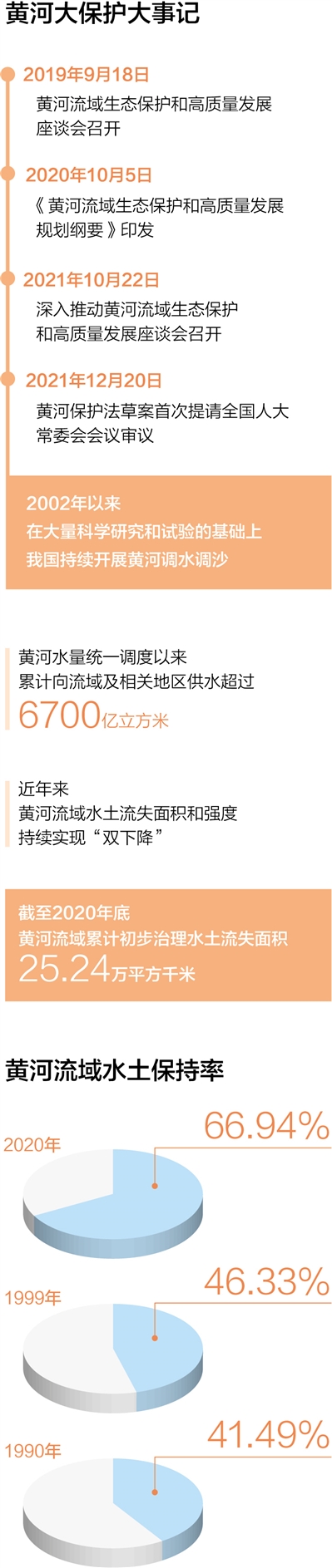
Since the unified water regulation of the Yellow River, more than 670 billion cubic meters of water has been supplied to the basin and related areas, which has supported the economic and social development and ecological civilization construction of the basin and related areas.
Water transfer — —
"Thousands of water intakes in the Yellow River have set quotas."
Venue: Head Gate Management Office of Liuyuankou Canal, Kaifeng, Henan — — The top of the Yellow River when it is cut off most severely.
There is no precedent to carry out unified water regulation in large rivers. How to adjust it?
Kaifeng, Henan Province, the first sluice management office of Liuyuankou Canal of the Yellow River Conservancy Committee, a sluice is like a "faucet", which draws water from the Yellow River to moisten the fertile fields. It is more than 700 kilometers away from the estuary, and it is also the top end of the Yellow River when it is most seriously cut off.
Shortly after the first water dispatching instruction was issued, the management office received the water quota — — Adjust 150 million cubic meters of Yellow River water every year. Qi Shushan, then the director of the management office, was worried: "In the past, the maximum amount of water diversion was 1 billion cubic meters per year, ‘ Faucet ’ Greatly tightened. "
Almost at the same time as the water dispatching instruction, it was the local villagers’ incomprehension: "The water is so small, can the ground be watered thoroughly?" … … At the peak of water use, nearby villagers gathered around the gate to beg for water.
Qi Shushan patiently persuaded the villagers, "What is the taste of a day without water? Everyone has tasted it. Both upstream and downstream are used sparingly, so that everyone can drink the Yellow River water. "
According to the dispatching requirements, the management office collects the water demand, reports the plan step by step in advance, and issues it for implementation after approval by the competent department. The water consumption is less, but the crops in this season have a bumper harvest, and everyone’s hanging hearts are also put down.
"Like the Liuyuankou Canal Head Gate Management Office, thousands of water intakes in the Yellow River have set a quota. The unified management and dispatching of water quantity reflects the fine scientific management of water resources. " Ke Sujuan said that in many years of practice, the water resources management model of "the state uniformly distributes water, the provinces (regions) are responsible for water distribution, the total water consumption and cross-sectional flow are controlled, and the important water intakes and key reservoirs are uniformly dispatched" has gradually matured.
Water saving — —
"What is water saving? On the way from irrigation area to Tiantou, the less the Yellow River water is lost, the better."
Venue: Dayudu Irrigation District, Yuncheng, Shanxi — — High irrigation project of diverting water from the Yellow River and national large-scale irrigation area
The Yellow River in Wan Li cuts across the mountains and passes through the Shanxi-Shaanxi Gorge.
In Dayudu Irrigation District, Ruicheng County, Yuncheng City, Shanxi Province, a series of water pipes climbed on the loess high slope with thousands of ditches and valleys, which led the Yellow River water to rise more than 300 meters and irrigated more than 500,000 mu of fertile land.
More than 1,000 mu of farmland owned by Hu Tianni, a large grain grower in Ruicheng County, "drank" the Yellow River water. Summer crops are good, autumn crops grow well, and water is the key.
Datian sticks out a sprinkler every 18 meters, taps the mobile phone, the water pump starts, and the trickle flows along the pipeline at a depth of 1 meter underground to the ridges. "In recent years, I have invested in the purchase of buried sprinkler irrigation equipment, from flood irrigation to small irrigation, and the water consumption per mu has been reduced from 150 cubic meters to below 60 cubic meters." Hu Tianni said.
A ballad tells the story of the "difficulty in using water": living along the Yellow River, drinking water is more difficult than oil, surging water flows eastward, and drought makes people worry. In 1993, Hu Tianni contracted more than 20 mu of land. At the peak of water use, she had to carry a pump to the Yellow River to pump water day and night, and it would take ten days to water it at least once.
"The Yellow River water is hard-won, so we should use it carefully." Today, with sprinkler irrigation equipment, Hu Tianni’s more than 1,000 mu of wheat saves 480,000 cubic meters of water, saving more than 160,000 yuan. After tasting the sweetness, Hu Tianni is more energetic, and new technologies such as sprinkler irrigation equipment, sensors and Internet of Things are constantly introduced.
From the field to the source, water-saving technology has gradually covered all links, and the water-saving transformation of Dayudu Irrigation District has been continuously promoted.
"What is water saving? On the way from the irrigation area to Tiantou, the less the Yellow River water is lost, the better. In technical terms, it is to improve the effective utilization coefficient of irrigation water. " Dang Chao, director of the secondary station of Dayudu Irrigation District Hub, said.
Water flows from the Yellow River to the bucket canal. Douqukou is the place where the irrigation area delivers water to the masses. "In the past, there were different standards for measuring weir and draft gauge at the mouth of the bucket, and there was no accuracy in how much water was put." Dong Zengwu, director of the Dayu River Pumping Project Administration, introduced. After repeated tests, a steel plate weir with uniform specifications was installed in the irrigation area, with higher accuracy and consistent standards.
The flowmeter on the canal is also related to water saving. There is a lot of sediment in the Yellow River, and the errors of ultrasonic and radar flowmeters are large. "We started technical research and improved more than 10 functions of magnetostrictive flowmeter." Dong Zengwu introduced.
At present, the effective utilization coefficient of irrigation water in irrigation area is 0.5518, which is 0.0818 higher than that before the implementation of water-saving reconstruction and continuous construction supporting projects, and the average irrigation water per mu is 191 cubic meters, which is 67 cubic meters lower than that before the implementation of the project.
Through the promotion of water-saving agriculture and the implementation of water-saving transformation in irrigation areas, the effective utilization coefficient of farmland irrigation water in the Yellow River Basin has increased from 0.554 in 2019 to 0.566 in 2020, and the actual average irrigation water consumption per mu of cultivated land is lower than the national average.
The biggest contradiction in the Yellow River Basin is the shortage of water resources, and the utilization rate of water resources is as high as 80%. "To manage the Yellow River, we must fight hard to save water and control water, insist on setting the city, land, people and production by water, and make good use of water resources carefully." Jing Ming, chief engineer of the Water Conservation Center of the Yellow River Water Conservancy Commission, introduced.
Water control — —
"This means that more sediment stays in the ditch and more water turns into clear water and gradually flows into the Yellow River."
Venue: Suide Scientific Experimental Station of Soil and Water Conservation, Jiuyuangou Valley, Yulin, Shaanxi — — An experimental station for water and soil control for 70 years.
Less water and more sediment, and the disharmony between water and sediment are the fundamental crux of the Yellow River.
Jiuyuangou, located in Suide County, Yulin City, Shaanxi Province, is one of thousands of gullies in the Loess Plateau, and the vertical and horizontal gullies connect the Wuding River, a tributary of the Yellow River. A soil and water conservation experiment that has been carried out for 70 years has explored the solution for water control and sand control.
Maliangou Village is located in Jiuyuangou, with fruit trees in the mountains and crops in the valleys. "Take apples as an example. The transfer fee for each acre of hillside is 55 yuan, and each person gets a bonus of 230 yuan every year. There are still 76 villagers working in the orchard, and one place can give birth ‘ Sanjin ’ 。” Wang Jianxiong, secretary of the village party branch, said, "Apple roots are deeply rooted and branches are scattered, which is still a way to prevent soil erosion ‘ Good hand ’ 。”
All this benefits from soil erosion control. In 1952, Suide Scientific Experimental Station of Soil and Water Conservation of the Yellow River Conservancy Commission was established. Researchers waded through mountains and rivers and surveyed the terrain. In the second year, the first warping dam in northern Shaanxi was built in Maliangou village.
Li Wenyuan, a villager, often heard the old people mention this dam. "The dam stops the sediment, and the water is drained from the building, leaving the soil behind. Layers of loess slowly silted the Cheng Liangtian in front of the dam. In a few years, in front of the warping dam ‘ Long ’ More than 150 acres of fertile land. "
"Silting dams can not only maintain soil and water, but also increase food production, which has become an effective measure." Party Weiqin, chief engineer of Suide Soil and Water Conservation Science Experimental Station, introduced.
Subsequently, a series of silt dams rose from the ground. However, at that time, the construction standard of warping dams was low and the flood control ability was poor. A heavy rain many years ago caused many warping dams in Jiuyuangou to collapse.
"From a painful experience, the standards, methods and materials for dam construction should be upgraded." Dang Weiqin said that the experimental station carried out a new round of exploration and put forward the idea of building a "warping dam system". "Large dams can play a role in intercepting floods and protect the safety of small and medium-sized warping dams downstream." Nowadays, in Jiuyuangou, large, medium and small warping dams cooperate with each other to form a relatively stable dam system, which greatly improves the safety performance of warping dams.
Continue to build warping dams and use engineering measures to maintain soil and water, or plant trees and grass and take biological measures? We set up "three lines of defense" from the bottom of the ditch, the hillside to the top of the beam: at the top of the beam, we will carry out grass-field rotation and plant economic forests; Planting soil and water conservation forest and artificial pasture on the hillside; At the bottom of the ditch, build large, medium and small warping dams according to local conditions. "Biological measures, agricultural measures, and engineering measures are combined, and layers of fortification and storage are stopped." Dang Weiqin said, "This means that more sediment stays in the ditch and more water turns into clear water and gradually flows into the Yellow River."
Not only Jiuyuangou, but also small watershed comprehensive management projects have been continuously promoted. In recent years, the area and intensity of soil and water loss in the Yellow River Basin have been continuously "double declining".

关于作者